
Until now, systematic discussions of gender, race and law have received little attention from Dutch law faculties, especially at the undergraduate teaching level. At the same time, public calls for discussion of these issues increases rapidly. The internet has enabled movements against gender-based harassment (#MeToo) and race-based police brutality (#BlackLivesMatter and #SayHerName) to the connect on an international scale, while local organizers have continued to call attention to what makes each of these movements unique to a given place. Legal instruments against unequal treatment based on race or gender have existed for decades at both the national and international level, but don’t seem to be sufficient or adequate to address continuing inequalities.
In order to introduce these topics to students, Honours College Law (HC Law) hosts an Honours course at the Law faculty, called ‘Gender, Race, Intersectionality and Law’. In this course, the students learnt some of the histories, theories and challenges of seeking equal justice under the law. With concrete examples focusing on gender and race, they explored the intersections between various aspects of individual identity, national and international legal institutions, politics and law. The students, in groups, have researched on six topics as their case study: (1)Rape law, (2)Abortion law, (3)Child marriage, (4)Female genital mutilation, (5)Racial profiling, and (6)Workplace discrimination. In this Conference Day, taking place in the beautiful Lorentz zaal of Leiden Law School building KOG, they presented their research outcome, engaged in discussions, learnt to give and receive feedback on their research.
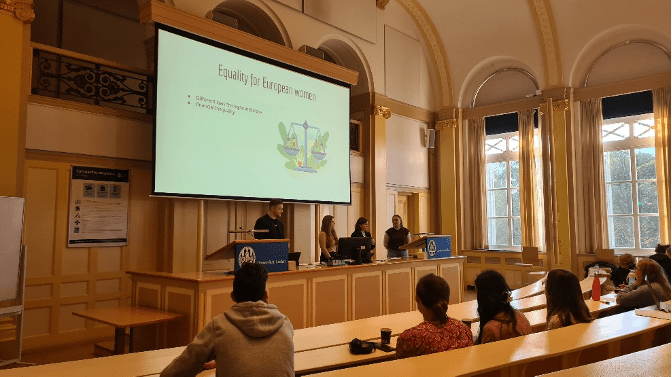
From concrete examples focusing on gender and race, students explored the intersections between various aspects of individual identity, national and international legal institutions, politics and law. The students, in groups, have researched on six topics as their case study: Rape law; Abortion law; Child marriage; Female genital mutilation; Racial profiling; and Workplace discrimination.
In ‘Aborting National Abortion Laws’, the first group explored the possibility and advantages of regulating abortion on a European level. By comparing the abortion laws of Poland, the Netherlands, Malta, Italy, they argued that such European regulation benefits women with increased equality, women’s health and safety, as well as legal certainty. In the discussion, we also discussed whether such regulation would be feasible or even desirable, as the abortion discussions at national level are inherently tied to cultural and religious issues.
In ‘A New Definition of Rape Law: Are the Victims Better Off?’, the students addressed the new Dutch rape law and examined to what extend it is going to impact the protection of rape victims. By the survey they conducted themselves with 120 respondents, they found that 20% of them has heard of the new rape definition. ———
In ‘Decolonizing Human Rights: The Dominating West in the Fight against Child Marriage’, they investigated the child marriage practice and relevant national legislation in India, Zimbabwe, and the US, in order to investigate to what extend the ‘universal’ human rights framework poses a challenge in the fight against child marriage. Addressing that there exists a stereotypical victimization of ‘Third World Girls’ as powerless, dependent, victims of patriarchy and male-dominated religions, they argued that the ‘universal’ framework is inherently Western centric, and such framework is problematic because of its exclusionary nature and insensitivity to different perceptions.
In ‘Fighting Female Genital Mutilation: Kenya versus Somalia’, they seek for an explanation on why the two neighboring countries in Africa shows radically different prevalence of FGM practice. They addressed the political, social, economic factors, as well as the recent history of relevant legislation in both countries, which helped us understand why Kenya has succeeded in combating the practice in the last decades, and not Somalia. FGM is one of the culturally sensitive gender inequality issues. In the discussion, they addressed this by questioning whether we can justify the fact the male circumcision is more accepted in the West than the FGM that is much more condemned as a ‘foreign’ practice.
In ‘Dutch Court Allows Ethic Profiling’, they examined the judicial decision made about the racial profiling practice of the Royal Netherlands Marechaussee (Kmar). They worked with the concept of effectiveness and proportionality, and by showing various negative consequences of ethic profiling (e.g., feeling of ‘second-class citizens’ and decreased trust in the state authorities, confirmation bias, reversed deterrence), they concluded that the judge should not have allowed the practice considering the proportionality principle.
In opening ‘Peter’s Privilege: on the implementation of a female quotum in top management and boardroom positions in The Netherlands’, students greeted the audience by introducing their names: they all called themselves ‘Peter’. It comes from an awareness-raising project in which female executives changed their names on LinkedIn to ‘Peter’, pointing out that there are more ‘Peter’, men in the position of management and boardroom. They compared the Dutch legislation of female quotum system with the ones of Germany, France, and Norway. Their conclusion is that enforced (rather than voluntary), two-tier (both management and boardroom position rather than one) regulation with sanction (rather than without sanction) is the most effective to increase the female representation in those positions.
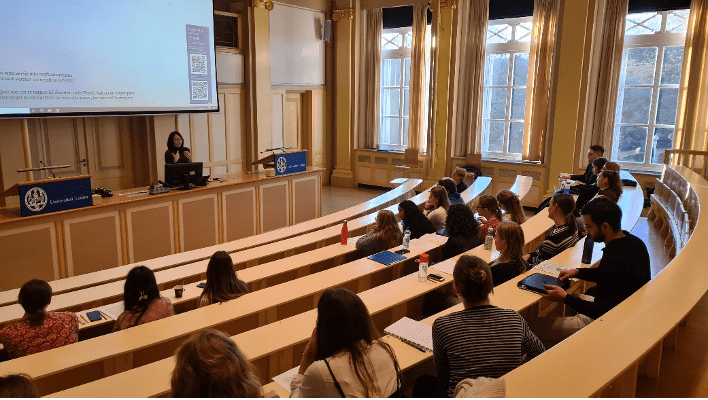
The presentations were highly informative, touched upon topical and important affairs, and were done in creative ways. The discussion was moderated by the course coordinator, and the students and audience engaged in a vibrant, cordial, critical yet constructive manner. Based on the feedback and insights the students gained from the day, they will write a blog post on the topic of their research.
 Hoko Horii